
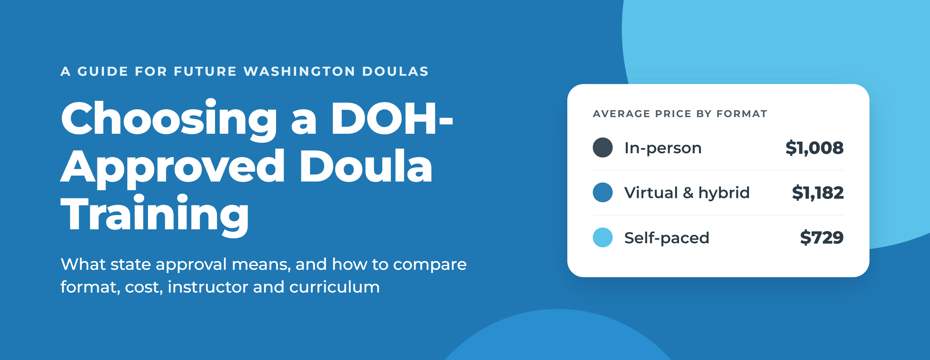
The Variability of Washington State DOH-Approved Doula Training Programs - Choose Carefully
If you’re planning to become a state-certified birth doula in Washington, one of your first big decisions is which training to take. The Washington State Department of Health (DOH) currently lists 43 approved birth doula training programs, and they range from weekend workshops in Seattle to recorded online courses based in other states. Every one of them has been approved by the state. But approved doesn’t mean equal.
This guide walks through what DOH approval tells you, what it doesn’t tell you, and how to compare programs on format, cost, instructor experience, and curriculum so you can pick the training that will prepare you to support families with confidence.
What DOH approval tells you, and what it doesn’t
To be approved, a program’s curriculum must introduce students to the key principles of six topic areas defined in WAC 246-835-020:
- Role of a birth doula: history of birth work, scope of work, individual practice and skill set, and when and how to refer out.
- Prenatal and birth care: prenatal wellness and birth preparation, labor and birth physiology, comfort measures, coping and pain management, common medical terminology and interventions, and birth planning.
- Postpartum care: lactation and newborn feeding, newborn care, family bonding, healing and comfort measures, postpartum mood and anxiety disorders, self and community care, and grief.
- Communication and interpersonal skills: collaborating with the birth team, emotional intelligence, active listening, informed consent and decision-making, advocacy, accessible and affirming language, and community support networks.
- Doula safety and self-care: client boundaries, capacity and burnout, emotional wellness practices, networking, and community building.
- Birth justice and advocacy: LGBTQ+ and gender-inclusive care, Black and Indigenous perinatal health crises, medical racism, and advocacy.
That’s a solid foundation, and approval gives you confidence that these subjects are in the curriculum. But notice the wording: programs must introduce the key principles. The rule doesn’t set a minimum number of instructional hours, require live instruction, require hands-on skills practice, or set standards for instructor experience. Two approved programs can cover the same six topics in very different depth.
That’s where your own research comes in.
Compare the three training formats
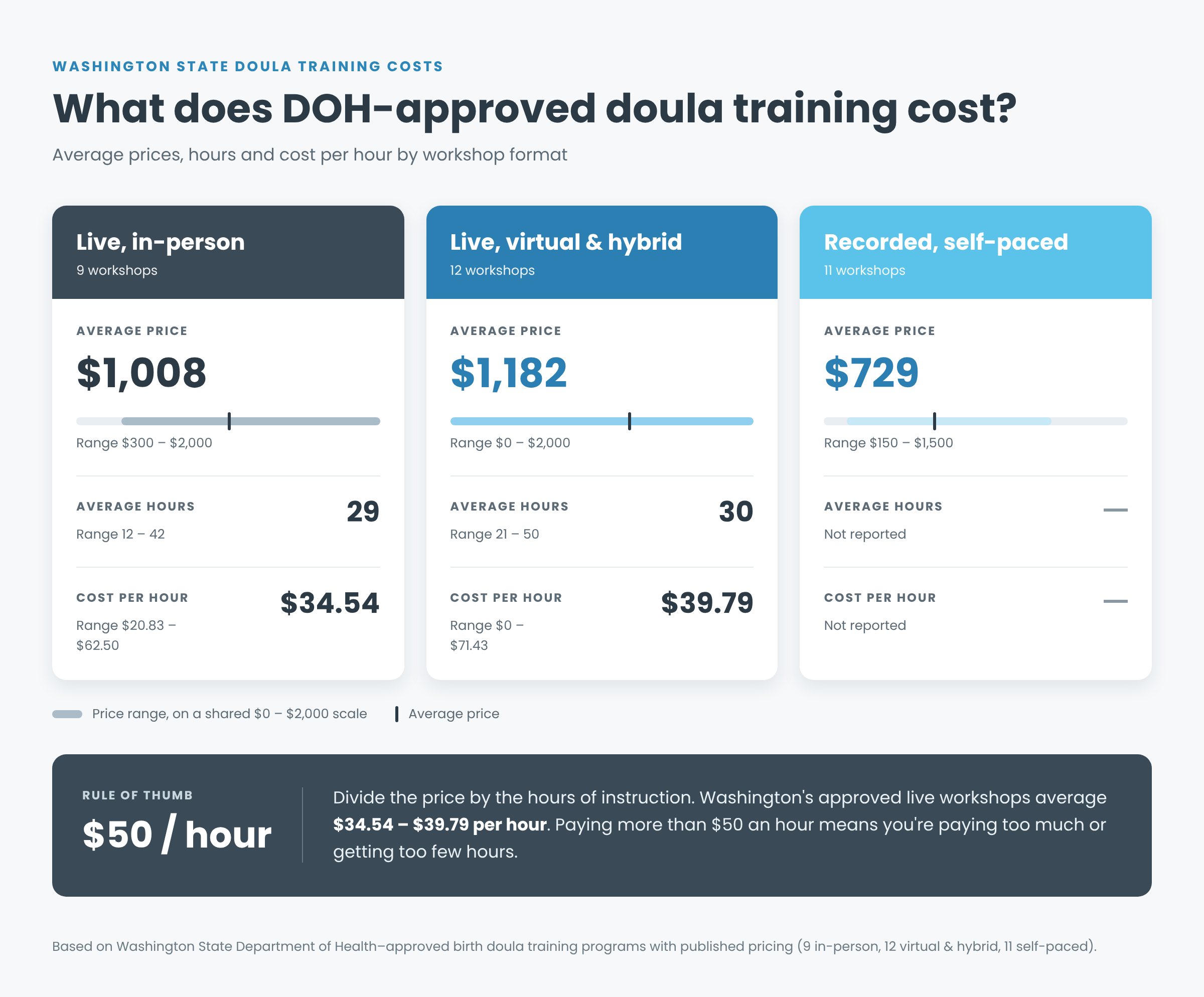
Washington’s approved programs fall into three broad formats. We reviewed the approved programs that publish their format and pricing and found:
Live, in-person workshops
In-person training is still the gold standard for learning the hands-on parts of doula work. Research on in-person learning shows gains not just in knowledge, but in practical skills and social competencies. You get real practice with comfort measures, positioning, and touch, plus immediate feedback from an experienced trainer and the chance to build relationships with other new doulas in your region.
The trade-offs: you’ll need to travel and block out dedicated time, and intensive formats packed into a few long days can be a lot to absorb. Look for programs that give you time to practice, not just listen.
Live, virtual and hybrid workshops
Live virtual training is often the most convenient option, especially if you live far from Seattle, Olympia, or Spokane. You still learn in real time from an instructor and interact with classmates. Interestingly, in our review, live virtual programs averaged slightly higher prices and cost per hour than in-person programs, so don’t assume virtual means cheaper.
The quality of a virtual training depends heavily on how much hands-on practice it builds in. Some doulas trained entirely online report feeling less prepared in physical comfort skills. Ask how the program teaches touch and positioning: do you practice on a partner at home, attend an in-person skills day (hybrid), or just watch demonstrations?
Recorded, self-paced courses
Self-paced courses are the most affordable on average and the most flexible. You can study on your schedule, rewatch lessons, and move at your own speed. These courses work well as an introduction if you’re still exploring whether doula work is right for you, or if you already have significant perinatal experience (for example, as a nurse, lactation consultant, or childbirth educator).
The trade-off is limited or no live instruction. Without practice and feedback, it’s hard to build confident, competent skills from recordings alone. Many self-paced programs also don’t publish how many hours of instruction they contain, which makes them hard to compare. If you choose this format, plan to find mentorship and hands-on practice elsewhere.
Compare cost per instructional hour
Sticker price alone can be misleading. A $600 training course with 12 hours of instruction costs more per hour than a $1,200 training course with 40 hours. To compare fairly, divide the price by the number of live instructional hours.
Across Washington’s approved in-person and live virtual programs, the average cost runs about $35–$40 per instructional hour. If a program costs well above $50 per hour, ask why. It may be overpriced, or it may offer fewer hours of instruction than you’d expect. Keep in mind that some community-based programs are offered free or at low cost through grants, so a $0 price can be a great opportunity rather than a red flag.
Also ask what’s included: training manuals, business resources, mentorship, and support after the workshop can add real value.
Choose the right instructor
Your trainer shapes how you’ll practice for years. Look for someone with extensive hands-on doula experience, ideally a decade or more of attending births, plus training or experience in adult education, group facilitation, and curriculum development. A great doula isn’t automatically a great teacher.
A reputable trainer should be happy to share their background, how long they’ve practiced, and how long they’ve been training doulas. Reviews from past students, especially doulas now working in your community, are worth seeking out.
Choose the right curriculum
Every approved program covers the six required topic areas, but ask for a syllabus and learning objectives so you can see how deeply each topic is covered. Questions to ask:
- How many total hours of live instruction are included? Live workshops of 24 hours or more give you more room for practice and discussion.
- How much of the time is hands-on skills practice?
- Does the program include culturally congruent ancestral practices content that satisfies WAC 246-835-025, or will you need to complete that separately?
- Does the program offer support after training, such as mentorship, study groups, or help finding your first clients?
Washington-specific things to check
- Confirm the program is on the current DOH list. Programs must reapply when their courses change, so check the list on the DOH website before you enroll.
- Consider where the program is based. About half of the approved programs are based outside Washington. That’s not a problem in itself, but a local trainer may know Washington hospitals, birth centers, and community resources, and can connect you with doulas in your area.
- Think ahead to how you’ll work. If you plan to serve clients through Apple Health (Medicaid), a community organization, or an employer benefit program, check whether they have training requirements of their own before you choose.
- Plan for continuing education. Washington certified birth doulas complete 10 hours of continuing education each renewal cycle, so a trainer who offers ongoing learning can be a long-term resource.
The bottom line
Any DOH-approved program will get you through the state’s certification requirements. But the goal isn’t just certification. It’s being ready to walk into a birth room and truly help. Compare format, cost per instructional hour, instructor experience, and the depth of the curriculum, and choose the training that matches how you learn and the kind of doula you want to become.
Resources
- Washington State DOH: Approved Birth Doula Training Programs
- WAC 246-835-020: Approved birth doula educational programs
- Chapter 246-835 WAC: Birth Doula
- Washington State DOH: Birth Doulas
- Choose Your Doula Training Wisely
These are the 32 DOH-approved training programs we used to compile the numbers above. Nine training programs listed on the DOH website did not have any training program information listed on their websites. For the most accurate pricing for each training program, please visit their website for updates.
| Training Program | Hours | Price | Price/Hr |
| Becoming a Birth Doula | $197 | ||
| Birth Arts International | $790 | ||
| Birth Journeys | 19 | $725 | $38.16 |
| Birth Restored Ministries | $1,500 | ||
| Birthing From Within | $1,500 | ||
| Birthing Roots Midwifery Services, LLC | 17 | $650 | $38.24 |
| BirthPro Advanced Doula Training | $895 | ||
| Blissful Birth Intentions | 32 | $825 | $25.78 |
| Born Again Academy | 28 | $2,000 | $71.43 |
| Capital City Doula Services | 24 | $580 | $24.17 |
| Center for Indigenous Midwifery | 22 | $0 | $0.00 |
| Community Doula Alliance | 50 | $2,000 | $40.00 |
| Cornerstone Doula Training | $693 | ||
| DNT | $199 | ||
| Doula Love | 42 | $875 | $20.83 |
| Doulaing the Doula | 35 | $850 | $24.29 |
| Doulio | 24 | $1,600 | $66.67 |
| House of Akoma University | $555 | ||
| Kim James DONA International-Approved Workshop | 32 | $800 | $25.00 |
| Mama Glow | 21 | $825 | $39.29 |
| Mother Tree International LLC | 40 | $1,500 | $37.50 |
| Newmom.me | $849 | ||
| Oxytocin World | 24 | $750 | $31.25 |
| Paradigm Doulas | $695 | ||
| Sharon Muza Birth Doul YOUR Way Workshop | 32 | $825 | $25.78 |
| SMC Full Circle Doula Birth Companion Training | 32 | $1,748 | $54.63 |
| The Black Doula Inc. (BADT) | 24 | $1,500 | $62.50 |
| The Madriella Doula Network | $150 | ||
| The Nest, Family Resource Support Center | 12 | $300 | $25.00 |
| Uzazi Village Perinatal Doula Training | 32 | $2,000 | $62.50 |