
Choose Your Doula Training Wisely
If you’re thinking about becoming a doula, one of your first big decisions is where to train, and the options can feel overwhelming. There are more than 300 doula training programs, and they vary widely in quality, length, depth, and the teaching credentials of their instructors.
People have been debating why there are so many doula training programs for at least a decade. In 2017, my colleague Amy Gilliland, PhD, wrote about how widely doula training programs vary. And earlier this year, we created a rubric for evaluating doula certification organizations. Both resources offer a helpful framework as you start researching the program that’s right for you.
A good place to start is format. Doula workshops are typically offered in one of three formats, and each has its pros and cons.
Recorded, self-paced courses. These courses have no live instruction and no instructor involvement. They’re best for people who aren’t yet sure doula work is for them. Most are survey courses: they describe the doula’s role, but they won’t actually prepare you to do the work. If a course is self-paced with no live instructor and costs less than $300, think of it as a fun, low-stakes way to find out whether you’d enjoy being a doula. Unless you already have significant experience in a perinatal profession, you likely won’t come away with the skills to do the work confidently and well.
Live virtual courses. An instructor teaches these courses in real time in an online classroom, using a platform such as Zoom or Microsoft Teams. Live virtual programs are often the most convenient option, especially if you would otherwise have to travel for training, and they can cost similarly as in-person workshops. With the right instructor, a virtual program can deliver excellent content and prepare you well for doula work. Much depends on how much hands-on skills practice and interaction is built into the course. Some doulas who train only virtually feel underprepared in physical comfort skills.
Live in-person workshops. The in-person workshop is still the gold standard for doula training. A 2024 study, Students’ Perception of Online Versus Face-to-Face Learning: What Do the Healthcare Teachers Have to Know? (Siddiqui et al., Cureus), found that in-person learning led to increases in knowledge (44.9%), clinical skills (52.7%), and social competencies (52.7%). As with virtual training, quality depends heavily on the instructor’s skill and experience, but you’re more likely to get real practice time with the skills you’ll use as a doula in an in-person workshop. The downside: some doulas feel overwhelmed by the amount of information, especially in an intensive format (one solid week of training rather than sessions spread over several weekends or months).
Format matters, but so do two other factors: the instructor (sometimes called the trainer) and the curriculum, including both what’s covered and how many hours of instruction you’ll receive.
Choosing the right instructor. In her 2025 study, A novice to expert analysis of skill development in birth doulas, independent doula researcher Amy Gilliland, PhD, identifies five stages of doula skill development, from novice (fewer than 50 births) to expert (200–400 births). You want to learn from an expert, and reaching that level of skill generally takes at least 10–15 years of doula work. Beyond hands-on experience, a skilled trainer will also have training in curriculum development, group facilitation, and adult education. The trainer leading any program you’re considering should readily share their credentials and a curriculum vitae (CV) that documents their experience as both a doula and an educator.
Choosing the right curriculum. Always check how many hours of instruction a program offers. Any live doula workshop, whether virtual or in person, should run at least 24 hours; that’s the minimum needed to cover the content required to begin working as a novice doula. Many programs are longer, but none should be shorter. A good program will also readily share its syllabus and learning objectives. Make sure you know exactly what the training covers before you pay for it.
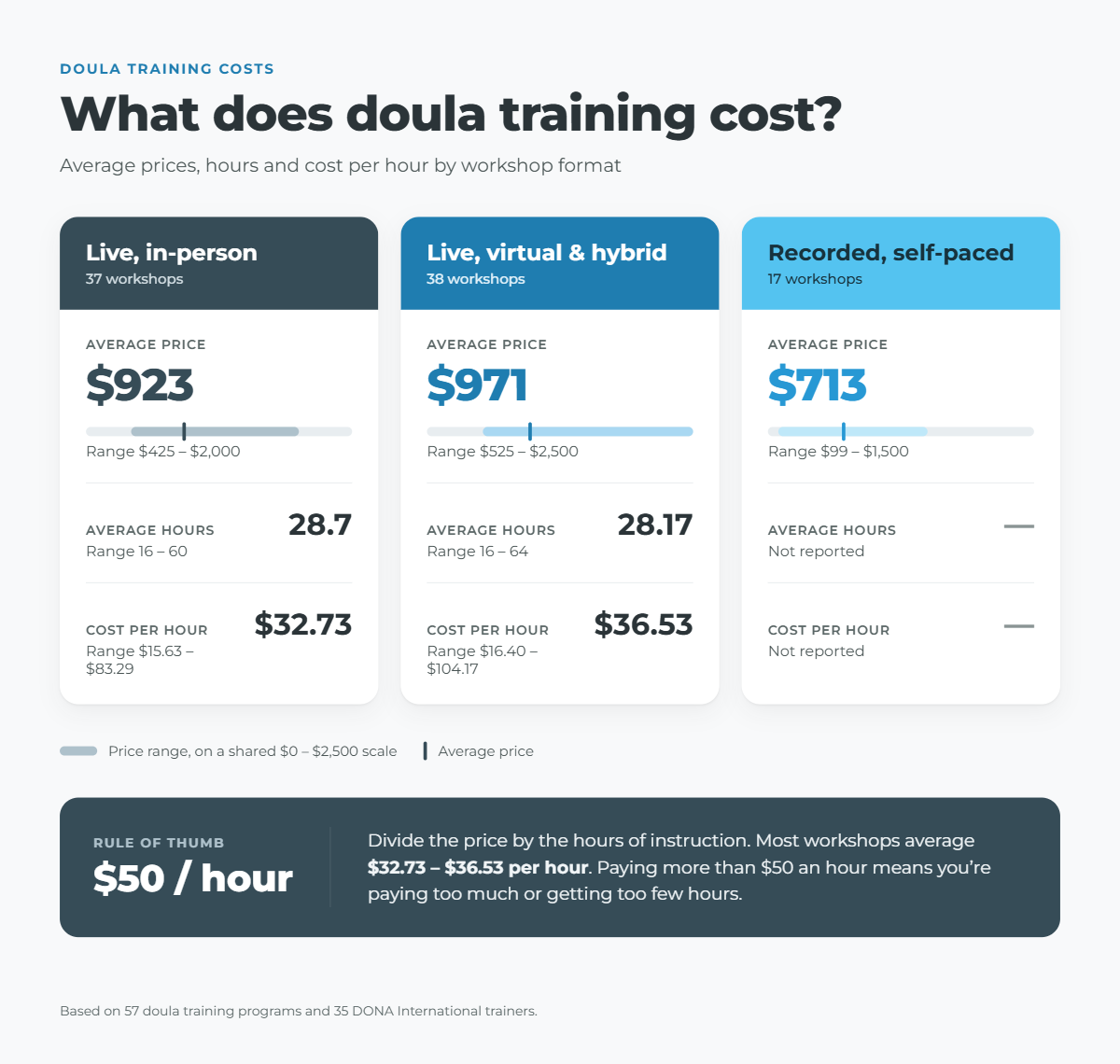
Comparing cost. The cost of doula training varies as much as the quality of instructors and curricula. The table below shows average prices for live in-person, live virtual, and recorded self-paced workshops, based on 57 training programs and 35 DONA International trainers. The most useful number to look at is the price divided by the hours of instruction. On average, workshops cost between $32.73 and $36.53 per hour of instruction. If you’re paying more than $50 per hour, you’re either paying too much or not getting enough instruction for the price.
Depending on how you plan to practice, there may be other factors to consider:
- If you plan to serve families covered by Medicaid, your state may require you to train with specific organizations.
- Some employer fertility benefit companies only work with doulas who trained with specific programs.
- Some certifying organizations set minimum content standards for doula training. If you plan to certify with a specific organization, make sure your training program covers the required topics and that those topics are listed on your certificate of completion.
Choosing the right foundational workshop will help you launch into this work as a confident novice doula.
These are the training programs used to create the graphic above.
A Healthy Birth |
Akwaaba Wellness |
Ancient Song Doula Services |
Bebo Mia |
Best Doula Training |
Birth & Beyond Resources |
Birth Arts International |
Birth Boot Camp |
Birth, Baby! Academy |
Birthing Advocacy Doula Trainings |
Birthing from Within |
Birthworks International |
Bliss Baby Yoga |
CAPPA |
Carriage House |
Charis Childbirth |
Childbirth Concierge |
Childbirth International |
Community Aware Birthworker |
Cornerstone |
Denver Health Community Doula Training |
DNT Network (Bornbir Online Training Program) |
DONA International (35 trainers) |
Doula Trainings International |
Doulaing the Doula |
Doulas Institute |
Expertrating.com |
Gifted Hands International |
Global Education of the Midwife (GEM) |
Great Expectations |
Happy Mama Healthy Baby Alliance |
Intentional Birth |
International Childbirth Education Association (ICEA) |
International Doula Institute |
Jamaa Birth Village |
Life Cycle Doulas (DoulaBrella) |
Lifespan Doulas |
Madriella |
Mama Glow |
MaternityWise |
Mère et Monde |
Modern Doula Education |
National Birth & Postpartum Professionals |
National Black Doulas Association |
Natural Resources |
New Beginnings Doula Training |
NewbornIQ |
Postpartum Support Academy |
ProDoula |
Rocky Mountain Doula |
Shafia Monroe Consulting Full Circle |
The Newborn Care Training Academy |
The Remembering |
The Village Doula Collective |
toLabor |
Ujima Maternity Network |
Warm Welcome Doula Academy |