
Confidently Supporting Induced Labors
The Art of the Tuck-In: Supporting Clients Through Induced Labor
If your client is having an induction, they will probably be in the hospital for a day, and sometimes two, before they need you to stay for continuous support. That does not mean you wait at home until then.
Induced labors need more emotional support, and they need it earlier. The doulas who show up early, and keep showing up, are the ones whose clients feel truly cared for. The doulas who wait miss so many chances to support their clients well. And clients notice.
Why induced labors are different
An induction is not just a spontaneous labor that started on a schedule. It asks more of your client, and it asks sooner.
- It's longer and more exhausting. Reserves can drain before strong contractions even start.
- There are many more medical decisions. Ripening methods, Pitocin, breaking the bag of waters, pain relief. Your client deserves support for each one.
- Emotional needs come earlier. Confidence is built, or lost, in the first hours.
- Early visits cement trust. The time you spend supporting your client's confidence and decision-making early on is what carries your relationship through the hard parts later.
The key touchpoints
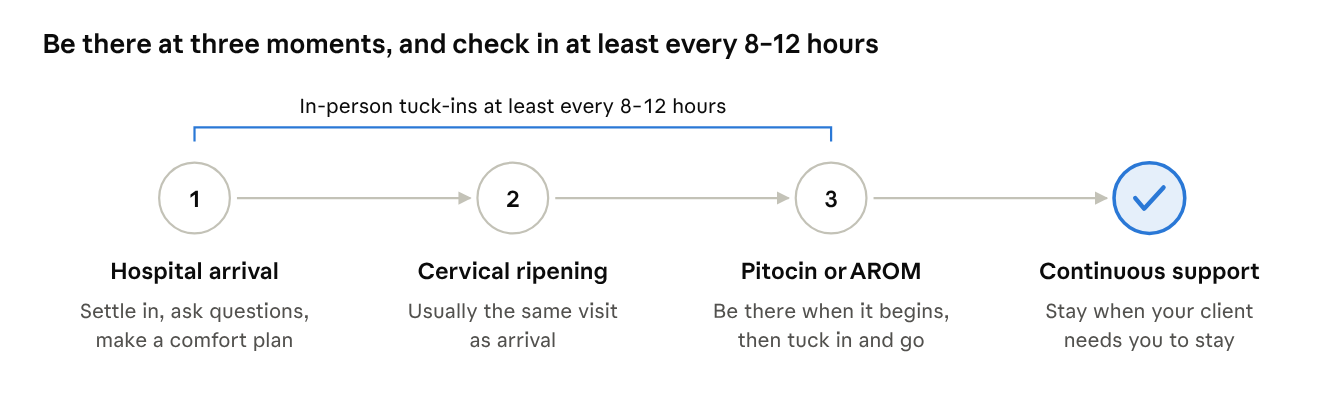
There are three moments when you should be physically present, and one firm rule for the time in between: never let 8–12 hours go by without an in-person check-in. Texts and calls are not a substitute.
- Hospital arrival. Meet them there. Help them settle in, ask about the timeline and methods, and make a comfort plan.
- The start of cervical ripening. This is usually the same visit as arrival, but not always. Some ripening methods bring on strong contractions quickly, and babies don't always tolerate them well.
- The start of Pitocin or AROM. Be there when it begins. Again, not all babies tolerate it well. If your client is coping well and contractions are mild, tuck them in and go, ready to return fast.
Then continuous support begins when your client needs you to stay. Because you've been there all along, you arrive as a trusted, familiar presence, not someone catching up.
The art of the tuck-in
A tuck-in is a short, purposeful visit. You arrive and provide emotional support, game-planning and advocacy for 30 to 90 minutes. Then you leave, once your client is settled and has a plan for the next phase.
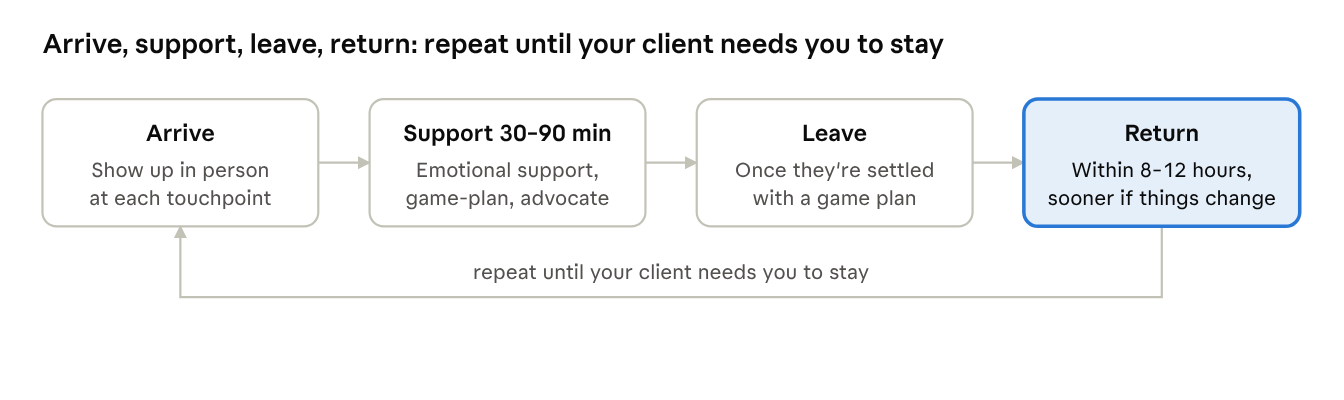
You repeat that at least every 8–12 hours, and sooner if anything changes, until your client needs you to stay. Frequent short visits show your care from the very start, and they put you in the room for the decisions that shape the rest of the birth.
Making each tuck-in count
A tuck-in only works if the time is well spent. Here's what that looks like.
During the visit
- Help them settle in and get oriented.
- Talk through the timeline and induction methods, and help them shape questions for their providers.
- Support informed decisions, and help them process the choices in front of them.
- Make a comfort plan for the next phase.
- Encourage rest, eating and light distraction while they can.
- Watch a few contractions to see how they're coping.
Before you leave
- Confirm they're settled and have a game plan.
- Name a clear next step and when you'll check in next.
- Make sure they know you can come back quickly.
Between visits
Respond eagerly to every update. Call, don't just text: you'll hear the worry a text hides. Clients sometimes hesitate to "bother" you, so you may want to reach out first.
Come back sooner if…
- Contractions build quickly after a ripening agent or a Pitocin increase.
- A new medical decision is on the table.
- There are concerns about how baby is tolerating things.
- Your client sounds anxious, discouraged or worn out.
"Active labor" is a medical label, not an arrival cue
Active labor (6 cm) is a clinical benchmark. It helps providers flag slow labors, but it was never meant to tell doulas when to show up. By the time labor is accelerating, about 70% of it is already over. Keep "active labor" out of your contracts, and respond to your client's emotional needs in every phase.
Clients notice
We can't control how a birth unfolds. We can control how promptly and warmly we respond. Arrive, support, plan, leave, and come back. Do that every 8–12 hours until your client needs you to stay, and you'll never miss the moments that matter most to them.
Further reading
- Gracefully Supporting Early Labor: Avoiding the Pitfalls of Under-Supporting the Earliest Parts of Labor
- Active Labor: A Medical Label That Doesn't Work for Us
- Body Ready Method early induction movement video
Big thanks!
Fellow DONA International-approved trainer, Jessica English at Heart + Soul + BirthPros coined the terms tuck-in and the art of the tuck- in to describe the important emotional support a doula provides before we remain continuously at induced labors. It is the perfect term to describe what we do and why it works.