_930x360.png)
Certification Rubric Coming
DoulaMatch.net is making changes to our Evaluating Doula Certifications page to help consumers better understand doula certifications. We will:
- Use a rubric (scoring guide) to assess specific components of a doula certification credential.
- Remove all organizations from our certification database that do not certify doulas.
Why Are We Doing This?
The doula training world is confusing the term certificate and certification. It is misleading and harmful to parents, aspiring doulas, and our profession. With over two hundred organizations in our current database claiming to certify doulas, we noticed a significant increase in training programs calling their training certificates ‘certifications’. The distinction between completing one's initial training program (earning a certificate) and completing a rigorous process of validation and verification of the doula’s knowledge and skillset developed over time and based on a predetermined standard is important.
Day Johnson of Cyberwox Academy explains it beautifully: “Certificate and certification are not interchangeable terms. They mean two different things. A certificate is awarded upon completion of a training course, workshop or program and demonstrates the individual has gained a certain, usually basic level of knowledge and skill to begin working.”
When a doula finishes their training course, workshop, or program, they receive a certificate, sometimes called a certificate of completion or certificate of attendance. A certification is a more formal and rigorous process that involves passing assessments that demonstrate the doula’s competencies (the skills required) of the doula’s accumulated knowledge and skillset through work experience and additional study. In the healthcare and allied healthcare professions, certification cannot be achieved until the professional has been in practice to become competent.
DoulaMatch believes all training programs, workshops and courses are valuable and have their place. Aspiring doulas need training programs that meet their diverse needs for learner ability, resources, time, and expectations. We want to see a wide variety of training programs exist to train the wide variety of doulas necessary to support a wide variety of families. When a training program participant successfully completes their initial training program, we believe participants should be awarded a certificate showing their completion of the program and their ability to begin working as a doula.
DoulaMatch.net does not believe certification is necessary to work as a doula. Being well-trained is great. However, having a certification should mean something extremely specific, and meaningful. Certifications should not be variable across two hundred credentialling organizations, with some certifications awarded by watching 10 hours of recorded videos and other certifications awarded through highly rigorous, multi-step processes. Consumers need complete confidence in what the doula knows and can do. Certification, by common definition, is about achieving predetermined, high standards.
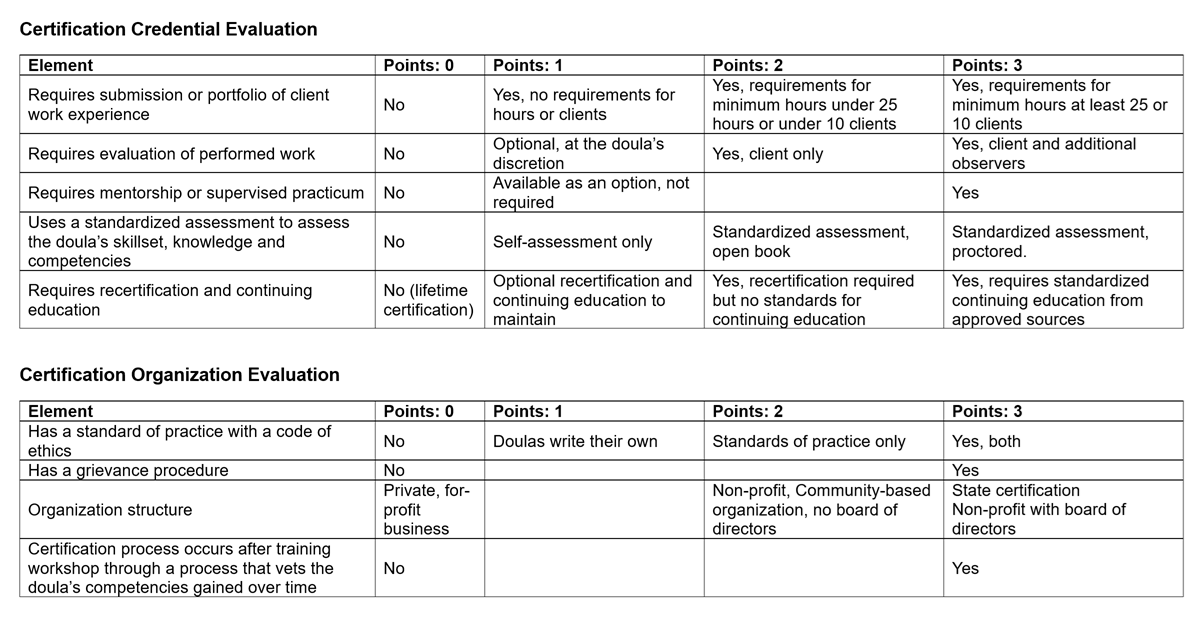
Below is the scoring guide, or rubric, we will use to help consumers and aspiring doulas understand the standards and rigor of each certification and certification organization. Currently there are no occupation-wide agreed standards for what a certified doula should know and be able to do. These rubric scores are the elements that demonstrate a learner’s progress along a continuum of skills over time and the professional standards of the organization.
Our blog post in February, 2026 explains our motivation for cleaning house: We Are Confusing Certificates of Completion with Certifications
References:
Difference Between Credentials & Certifications: https://www.neha.org/Credentials-Certifications
What's the Difference Between a Certificate and a Certification?: https://www.pce.uw.edu/news-features/articles/difference-between-certificate-certification
Certification vs. Licensure in Allied Health: https://www.bellevuecollege.edu/ahe/current-students/certification-vs-licensure/
Certificate vs Certification: https://www.youtube.com/shorts/TPAwNObeZy4
Day Johnson, Cyberwox Academy: https://www.youtube.com/shorts/TPAwNObeZy4
Not being certified can hurt: https://pmc.ncbi.nlm.nih.gov/articles/PMC10148253/
Certification and Training – What’s the difference and why do I need both? https://www.linkedin.com/pulse/certification-training-whats-difference-why-do-i-need-jim-lucari/
Not All Rubrics Are Created Equal: How Competency-Based Progressions Are The Way to Go https://learnercentered.org/blog/not-all-rubrics-are-created-equal-how-competency-based-progressions-are-the-way-to-go/