We Are Confusing Certificates of Completion with Certifications
We have a problem. With over 200 doula training organizations providing education of varying lengths and quality, (some more than 200 hours of quality, in-person instruction and some as little as 5 hours of recorded videos), we are seeing doulas practice with varying skillsets and knowledge. Some of these training programs promise their aspiring doulas they will be ‘certified’ at the end of their training program, sometimes for a lifetime. Consequentially, these doulas have varying practice abilities and have no incentive or understanding that further, future education is critical for developing their skillset and knowledge base.
It’s not the doulas fault. The doula profession has no single national certification board that sets standardized competencies for a standards of practice (what a doula does) or code of ethics (how the doula performs their work). The owners of DoulaMatch.net believe we have a social responsibility to uphold a professional standard that maintains what the evidence shows: The doula’s support role makes a difference in obstetric and emotional health outcomes.
First, Let’s look at the difference between training and certification:
Training is… acquiring the initial knowledge, skills and practical applications that a doula needs to do their job. The outcome is the ability to begin practicing as a new doula. The result of completing a training program is a certificate of completion, recognizing the successful completion of a training program.
Certification is… achieved by demonstrating a level of professional competency based on predetermined competencies and standards. It is vetting and validating of one’s knowledge, skills and abilities through accumulated work experience. The outcome of certification is a formal credential that recognizes the doula’s qualifications and competencies. Certification occurs after successful completion of initial training, not the result of the initial training and is typically administered by a professional, non-governmental organization.
Certification should not be confused with training certificates of completion. Think of training certificates of completion like a degree earned at a college or university. Once you earn your certificate of completion, you have it forever, much like a degree. You are a trained doula. Certification is different. A certification credential shows you can uphold the standards and can perform the competencies of a profession. A certification ensures the professionals, regardless of where they trained, meet these standards through experience and continuing education.
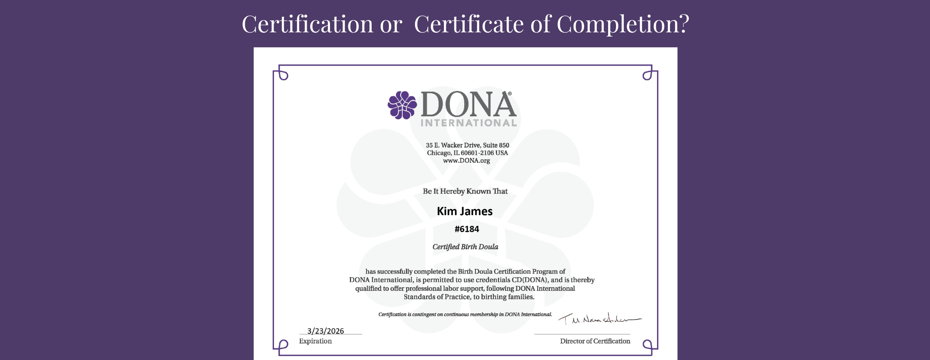
Sadly, some training organizations confusingly word their training certificates of completion as if they were certifications by using the words: “This certifies that TRAINING PARTICIPANT NAME has completed the TRAINING PROGRAM NAME.” Some doulas don’t understand they have a certificate of completion, not a certification certificate.
One argument you’ll hear is that certification doesn’t matter. You can practice without it and no one cares. But is that really true? When a profession uses certification, how does that support the profession and the professionals? When not used, who is hurt?
Ultimately, certification is about increasing a professional’s knowledge and skillset towards mastery for the protection of consumers. The same is true for the doula profession. When doulas achieve meaningful certification, we can expect to see these benefits:
Benefits for families:
- Certification improves workforce quality by setting and maintaining profession-wide standards
- Families feel more confident that they receive quality care when it is provided by a certified doula
- We can expect better client outcomes when parents are cared for by certified doulas
Benefits for doulas and doula profession:
- Ability to charge higher fees
- Increased confidence through a sense of achievement
- Positions the doula profession for recognition as a true para-profession and allows for better bargaining leverage with 3rd party payers
- Demonstrates a commitment to career development
- Demonstrates the profession is accountable for meeting its responsibility to the public
- Reassuring to other health professionaIs
- Incentivizes lifelong learning. The certification and re-certification process validates p rofessional experience and incentivizes doulas to continue their professional education and to stay engaged in their careers
When doulas are not certified, who gets hurt?
- Families get hurt. New knowledge is constantly entering the profession. Trauma-informed care principles, anti-racism work, health inequities, obstetrical violence, changes in standard precautions, body alignment and body mechanics are examples of topics that were not being taught in standard curriculums 10-15 years ago. Doulas who have no incentive, and no internal motivation, to pursue continuing education miss out on significant changes and their practices become stagnant, outdates and potentially harmful.
- The minimum standards for a doula’s basic knowledge change over time
- When doulas practice with outdated, or harmful practices, both healthcare providers and families become mistrustful
A future, national board certification process for doulas must prioritize two main factors: The process must be anti-racist, and it must not be “owned” by any specific training organization.
Certification programs and processes have been historically fraught with implicit biases and systemic racism. When creating an assessment process and standards for a national board and national doula certification, our history of racist systems must be considered and not rebuilt. Ensuring our QTBIPOC doulas are centered and at the center of leadership is key. Washington State sets an excellent, anti-racist standard by accepting an ancestral pathway for their State’s Department of Health Birth Doula Certification. All doulas, regardless of where or how they trained, must be eligible to certify and must have equitable ways to meet the certification criteria.
Historically, nearly every certification program has been tied to a specific training organization or private company. This contributes to different standards and doulas’ divergent ideas of what a doula does and how they practice. A national doula certification board and process will standardize the competencies for doulas regardless of where or how a doula trains for the role.
Especially now that over a twenty-two dozen States’ Medicaid insurance plans cover doula support and more employer benefit plans contribute towards the cost of doula expenses, the public’s expectations of what a doula does is standardizing. National certification could be the answer to increase confidence and decrease the variability in our profession.
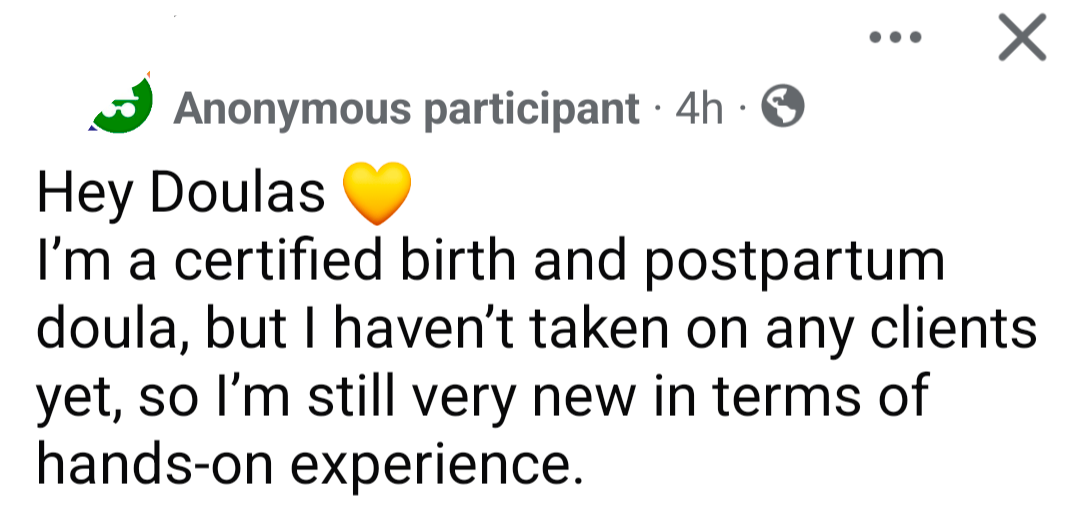
The example below shows a doula who is new and received a "certification" instead of a more appropriately named certificate of completion after their training program.
Key differences between training and certification: https://digitaldefynd.com/IQ/training-vs-certification/#:~:text=Purpose%20and%20Focus%3A%20Training%20is,often%20following%20a%20standardized%20assessment.
History of midwifery: https://www.ohsu.edu/womens-health/brief-history-midwifery-america
Training & certifying traditional midwives: https://pmc.ncbi.nlm.nih.gov/articles/PMC2804652/
https://edithlangford.com/granny-midwives-part-1/
Benefits of Nursing Certification: Why Get Certified in Nursing
https://nursing.maryville.edu/blog/benefits-of-nursing-certification.html
Impact of Certification: https://www.nccwebsite.org/about-ncc/ncc-recognizes-certified-nurses/impact-of-certification
Specialty Certification: A Path To Improving Outcomes: https://aacnjournals.org/ajcconline/article-abstract/30/2/156/31375/Specialty-Certification-A-Path-To-Improving?redirectedFrom=fulltext
Relationship Between Nurse Certification and Clinical Patient Outcomes: A Systematic Literature Review https://pubmed.ncbi.nlm.nih.gov/30817408/
The Value of Certification: https://www.aacn.org/blog/the-value-of-certification
Amy Gilliland’s excellent blog posts on doula certification: https://www.amygilliland.com/how-doulas-undermine-our-own-value-its-not-free-births/