Taking a Closer Look at DONA International-Approved Workshops
If you're ready to become a doula, choosing a training program is your first big decision. It can also be a confusing one. Workshops range from under $100 to $2,500, and every program says it's the best way to start.
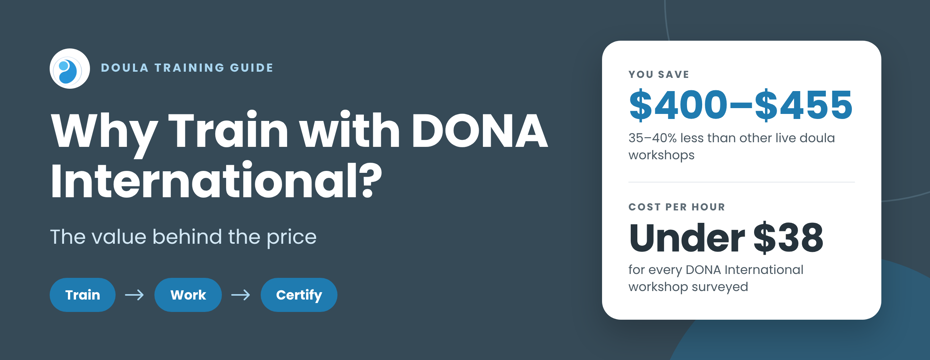
We looked at the fees for 92 doula workshops to find out what you actually get for your money. Workshops taught by DONA International trainers cost less, both overall and per hour of instruction, than live workshops offered by other organizations. And price is only part of the value: the DONA International path of train, work, then certify lets you start working right away and earn income while you build toward certification.
A DONA International workshop costs about $400 less
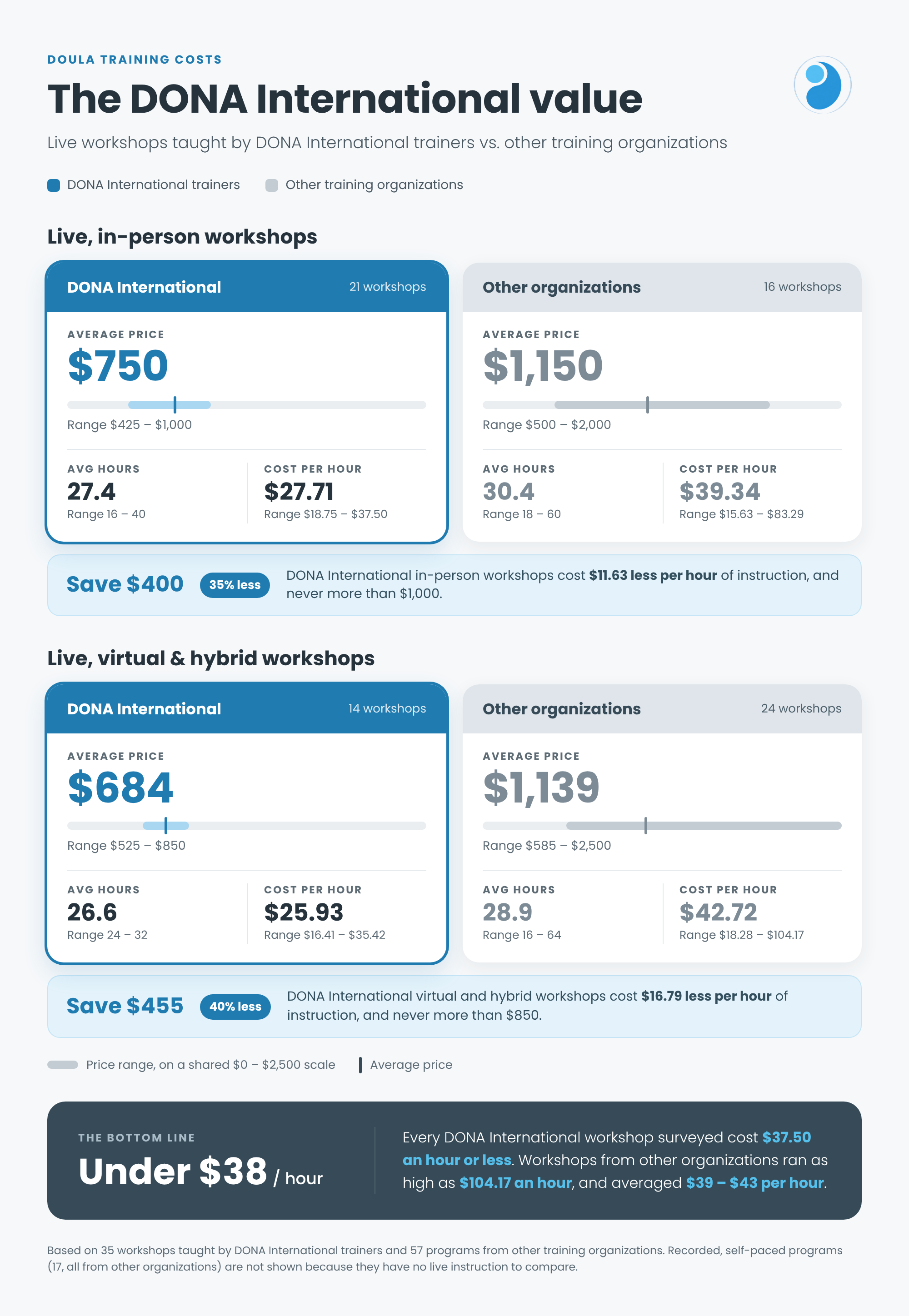
In both live formats, DONA International workshops cost 35–40% less than workshops from other organizations.
Live workshop format | DONA International avg. price | Other organizations avg. price | You save | DONA cost per hour | Others' cost per hour |
In-person | $750 | $1,150 | $400 (35%) | $27.71 | $39.34 |
Virtual & hybrid | $684 | $1,139 | $455 (40%) | $25.93 | $42.72 |
The price range tells the same story. No DONA International in-person workshop in our survey cost more than $1,000, and no virtual or hybrid workshop cost more than $850. Other organizations charged as much as $2,000 for in-person training and $2,500 for virtual training.
Look at the cost per hour
The fairest way to compare programs is to divide the price by the hours of instruction. Every DONA International workshop we surveyed cost $37.50 an hour or less. Other organizations ranged as high as $104.17 an hour.
DONA International workshops average 26–27 hours of instruction, while other organizations average 29–30. Even so, a DONA International workshop costs $11–$17 less for every hour you spend learning.
Train, work, then certify: how this system makes competent doulas
DONA International is designed to train you quickly and well so you can start working right away, then keep building your skills through certification.
- A DONA International-approved workshop gives you the core skills and knowledge you need to start supporting families.
- You can join the doula workforce as soon as your workshop ends and start earning income. While you gain experience, the larger DONA International certification community gives you support and guidance.
- Once you've built a portfolio of hands-on experience and further study, you apply for certification to show what you can do.
This is the same path that health care and allied health professions use. Training shows you have the basics to begin. Certification confirms your competence after you've practiced in the real world. Following this path makes each doula more skilled and raises the standard for the whole profession. Simply put, it makes better doulas.
Why this path costs you less
Some training programs award a "certification" at the end of the workshop, before you've supported a single family. A DONA International certification means you've proven your skills through real work.
You also don't pay for everything up front. DONA International workshops typically cost less, and you don't pay the certification fee until you have enough experience to apply. Meanwhile, you can be earning income as a doula.
What you get beyond a lower price
A lower price only matters if the training is good. Here's what comes with a DONA International workshop.
Training built on research. DONA International was founded in 1992 by Dr. Marshall Klaus, Dr. John Kennell, Penny Simkin, Phyllis Klaus and Annie Kennedy. Drs. Klaus and Kennell ran some of the first controlled trials on continuous labor support. That research is still the foundation of DONA International's evidence-based training.
A credential people recognize. DONA International calls itself the world's leading doula certification organization, and its member doulas practice in 56 countries. Families, care providers and hospitals know the name.
Clear standards and ethics. Every DONA International doula follows a published Code of Ethics and Standards of Practice. Clients know what to expect from you, and you know where your role begins and ends.
A community after the workshop. DONA Connect offers discussion forums and peer support, so you aren't on your own once training ends.
How to compare any doula training program
Whichever program you're considering, ask these questions before you pay:
- What's the cost per hour? Divide the price by the hours of live instruction. Most workshops average $33–$37 an hour. Paying more than $50 an hour means you're paying too much or getting too few hours.
- Is the instruction live? Recorded, self-paced programs can look cheaper, but most don't report how many hours of instruction you'll get. You also lose the chance to ask questions and practice skills with a trainer.
- Does it lead to a recognized certification? Find out what certification the workshop counts toward and how well families and care providers know it.
- Are there published standards and ethics? A clear code of conduct protects you and your clients.
- What support do you get afterward? Look for mentoring, continuing education and a community of other doulas.
A DONA International-approved workshop costs hundreds of dollars less than many alternatives. It gets you working, and earning, right away, with a respected certification path and a supportive community behind you as you grow. Find a DONA International workshop near you at dona.org.
About the data: We compared published fees for 35 workshops taught by DONA International trainers and 57 programs from other training organizations. The 17 recorded, self-paced programs we found all came from other organizations, so they aren't included in the DONA International comparison.